CUTS, MATCHING & ASSEMBLY
Natural Characteristics
How leaves are oriented on the door face determines symmetry, flow, and cost.
- Book
- Slip
- Random
- Continuous
- End Match

Overview
Real wood veneer varies in color, grain, figure, and natural characteristics—even within the same species or flitch. These differences help give wood its character, but they can also create surprises when the expected appearance has not been clearly defined.
Learn to recognize the characteristics, understand how they may appear across a full door face, and identify what to confirm before placing the order. The applicable face grade establishes permitted characteristics; your project requirements and approved appearance references help communicate the intended result.
At-A-Glance
What Face Grade Controls | What Face Grade Does NOT Control |
|---|---|
Which natural characteristics are permitted (and at what size or frequency) | Overall color tone, undertone, or sapwood-to-heartwood ratio |
Species-specific allowances for features like pin knots, mineral streaks, and gum pockets | The prominence of figure, ray fleck, or cross bars |
A defined quality threshold — not a definition of appearance uniformity | Visual differences created by matching method, assembly method, lighting, or finish |
"Specifying AA instead of A narrows the permitted characteristics — it does not define the appearance."
INDUSTRY DEFAULT
BookMatch
MATCH DESCRIPTION
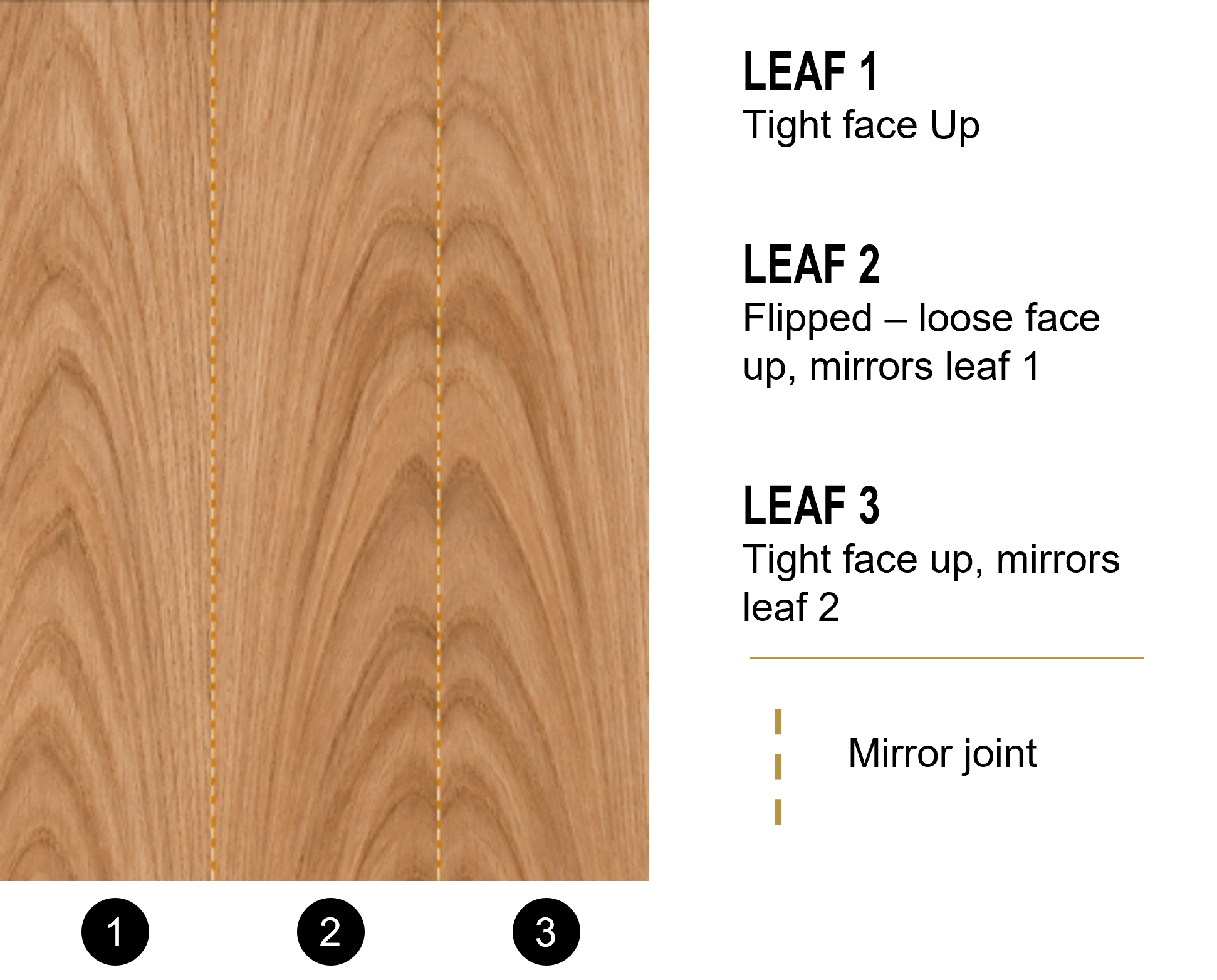
The industry standard and default method unless otherwise specified, book matching turns over every other veneer leaf so adjacent pieces mirror each other like the pages of an open book. Splicing the leaves creates a symmetrical, mirrored grain pattern at each joint line, repeated across the width of the door panel to achieve balanced visual continuity.
TYPICAL USE
Ideal choice for plain-sliced veneers and figured wood across standard and
high-end commercial interiors, including:
Education & Institutional: K–12 classrooms, university lecture halls, and administrative facilities.
Healthcare Facilities: Patient room doors, clinic corridors, and staff suites.
Hospitality & Multi-Family: Hotel guestroom entries, suite entries, and common area corridors.
Paired Commercial Entrances: Meeting room doors, conference halls, and vestibule pairs requiring mirrored symmetry across leaves.
Specification Watch Out:
01
Barber Pole Effect
Alternating “tight” and “loose” veneer faces can accept stain or reflect light differently, causing a visible alternating-light-and-dark effect often called barber pole. This is not considered a manufacturing defect.
Recommended response
When a more uniform appearance is desired, specify slip match to keep all veneer leaves oriented in the same direction and reduce light/dark striping. Note that slip matching may introduce color variation within individual leaves even as it reduces the barber-pole effect. Clearly define the matching method — book or slip — in the project specification to align with.
02
Mirrored Grain Does Not Guarantee a Centered Face
Book matching establishes the mirrored relationship between adjacent leaves—not their arrangement across the door. A book-matched face can still have unequal outer leaf widths or a pattern that is not centered on the opening.
Recommended response
Specify the face assembly separately. Where a symmetrical layout is desired, specify balance or center balance match in addition to book match. Keep in mind, this will add cost to the project. Identify any matching requirements for paired doors or sets, and review shop drawings showing veneer layout and joint locations.
Explore book-matched wood doors across a range of commercial settings. These examples demonstrate how veneer species, stain colors, and finishes accentuate symmetrical grain patterns and cathedral figures—from light, natural finishes to rich, contrasting wood tones.


SlipMatch
MATCH DESCRIPTION
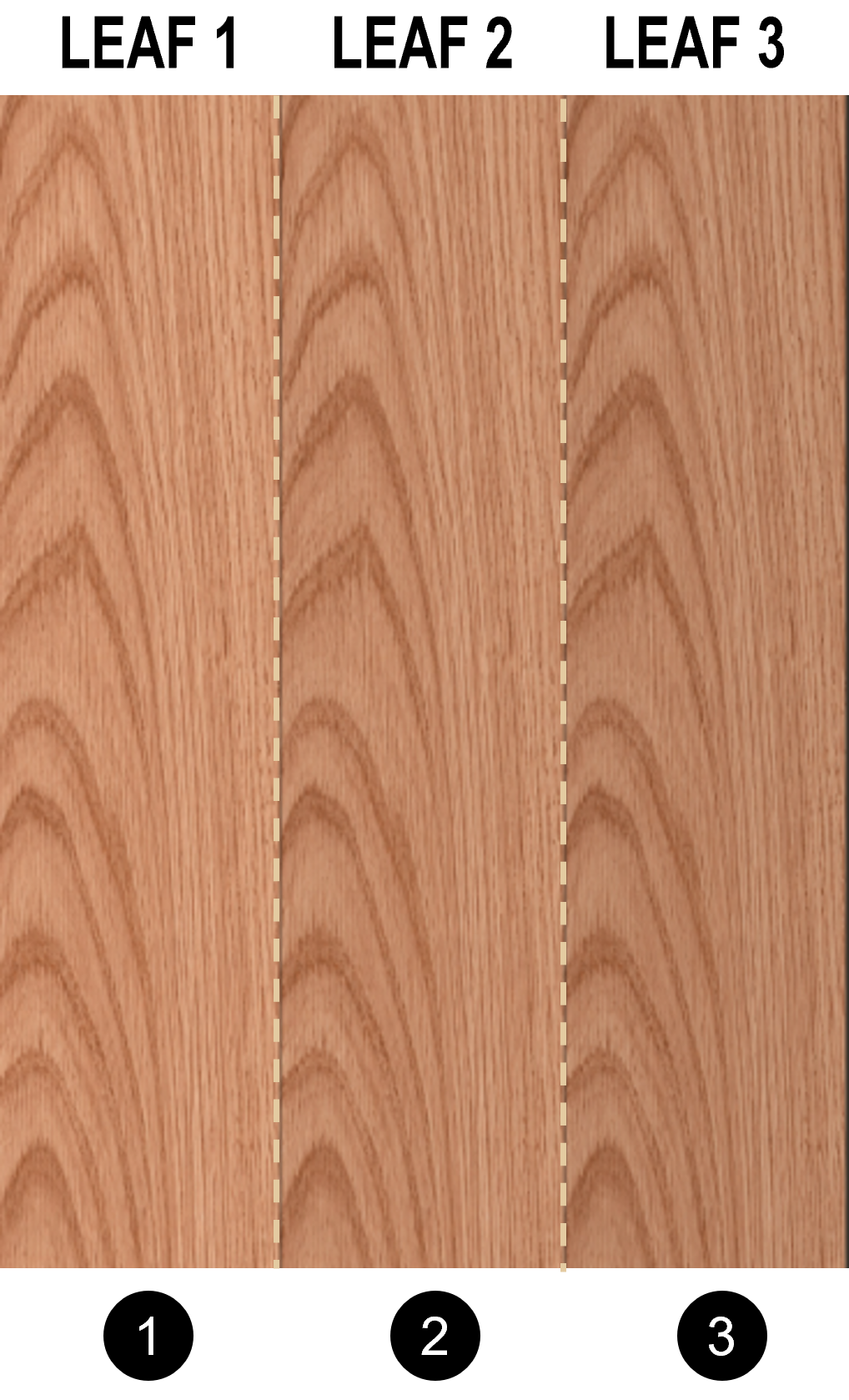
Slip matching places consecutive veneer leaves side by side in sequence, orienting the same face outward across the panel to create a repeating grain pattern. Maintaining consistent leaf orientation minimizes barber-poling (variation in light reflection across leaves), but does not eliminate natural variations in color, grain, or sheen. Grain lines do not align across joints, and sharp color contrasts may be visible where adjacent pieces meet.
TYPICAL USE
Commonly specified for quarter-sliced, rift-cut, and comb-grain veneers where a linear, repeating grain pattern is desired across commercial interiors, including:
Corporate & Office: Private offices, conference rooms, and tenant suite entries.
Hospitality & Multi-Family: Hotel guestroom entries, residential suite entries, and common area corridors.
Education & Healthcare: Classrooms, administrative offices, patient rooms, and staff areas.
Coordinated Architectural Interiors: Doors complementing linear-grain wall panels, cabinetry, and surrounding millwork.
Specification Watch Out:
01
Sharp Color Contrast at Joints
Slip matching is the second most popular veneer assembly and is often recommended for quarter sliced and rift cut. Adjoining pieces of veneer are placed in sequence in the same orientation, creating more consistent light reflection than book matching. However, it does not mirror the grain across the joint, so differences in color variation repeats across the face which can cause sharp color contrasts at the splice joint especially when “specifying natural” faces color.
Recommended response
Where color contrast at the splice joint is a concern, specify book match — alternating veneer leaves create a mirrored pattern that makes color transitions at the joints generally less noticeable. Adding a stain can also help mute the contrast between lighter and darker portions of each leaf. Where a more uniform, linear appearance is the priority, consider comb-grain or reconstituted veneer as an alternative.
02
Grain Slope & the “Out-of-Square” Effect
When slip match is specified, it mayo cause a sloping appearance of the veneer. Grain can go at an angle and make the door look like it is out of square when quarter cut, especially on taller doors over 7'.
Recommended response
To minimize this risk, specify grain alignment with the door’s vertical edges, coordinate acceptable slope and sweep with the manufacturer, and approve a full-height veneer layup or mockup before production.
Explore slip-matched wood doors across a range of commercial settings. These examples show how veneer species, stain colors, and finishes influence the appearance of repeating grain patterns—from light, subtle textures to rich, distinctive wood tones.


End/ContinuousMatch
MATCH DESCRIPTION
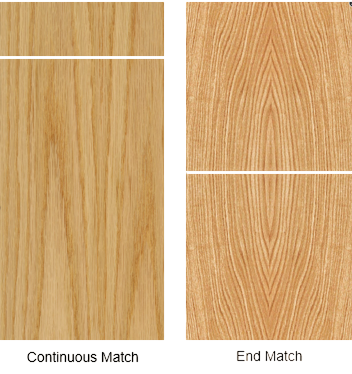
End and continuous matching coordinate the veneer grain between a door and its wood transom to create a unified opening. End match reverses the grain vertically at the horizontal joint, creating a reflected pattern, while continuous match carries the grain in the same direction from door to transom, maintaining grain and splice alignment. Both methods must be specified; continuous matching also requires sufficient veneer length for the combined opening.
TYPICAL USE
Ideal for door and wood transom openings where coordinated grain adds architectural interest and emphasizes height, including:
Corporate & Executive Interiors: Office entries, boardrooms, and conference suites.
Hospitality & Multi-Family: Suite entries, lounges, and amenity spaces.
Education & Institutional: Libraries, administrative offices, and reception areas.
Architectural Feature Openings: Tall door-and-transom assemblies designed to showcase reflected grain patterns or vertical grain continuity.
Specification Watch Out:
01
Matching Veneer Does Not Guarantee Matching Grain
Specifying the same species, cut, and stain for a door and transom does not establish their grain relationship. Continuous match carries the grain pattern from door to transom, while end match reverses the grain at the horizontal joint to create a reflected pattern.
Recommended response
Specify continuous match or end match explicitly, along with the veneer leaf match and face assembly requirements. Require shop drawings showing grain direction, splice alignment, and the intended transition between the door and transom.
02
Veneer Length Can Limit Continuous Matching
Continuous matching requires veneer long enough to accommodate the combined door and transom height, including manufacturing allowances. Availability varies by species and cut, which can limit options for taller openings.
Recommended response
Confirm veneer availability and maximum combined heights with the manufacturer before finalizing the specification. If sufficient lengths are unavailable, review end match or another coordinated treatment rather than assuming continuous matching can be achieved.
03
Frame Details Can Interrupt the Visual Match
A wide horizontal frame member, large reveal, or offset between the door and transom can interrupt the grain relationship. Even correctly matched veneer may not create the intended effect if the opening details obscure the transition.
Recommended response
Coordinate frame profiles, panel alignment, and joint details with the door and frame manufacturers. Review the complete opening—not just a veneer sample—and confirm that the desired appearance is compatible with attachment details and any fire-rating requirements.
Explore how wood doors with matching transoms elevate vertical scale and architectural continuity across commercial interiors. These examples illustrate the distinct visual impact of continuous match—where veneer grain flows unbroken from door to transom—versus end match, which mirrors the grain vertically across the horizontal joint to form a striking, symmetrical transition. Stains, finishes, and subtle reveals work together to emphasize how each technique frames the opening and complements the surrounding space.


RandomMatch
MATCH DESCRIPTION
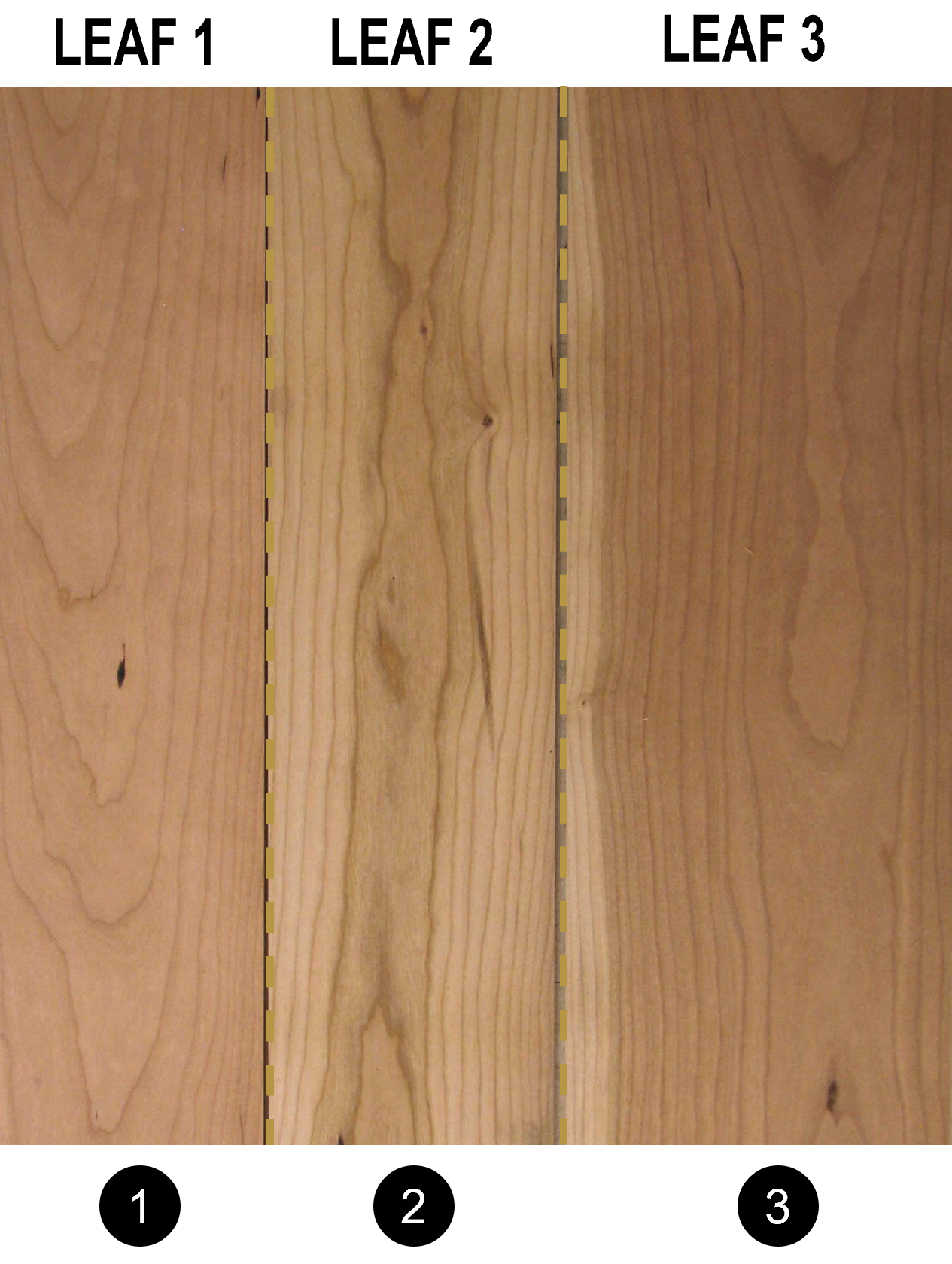
Random matching assembles veneer leaves without a repeating or mirrored sequence, highlighting natural differences in grain, figure, and color across the door face. Leaves may vary in width and appearance, creating an intentionally varied composition rather than a symmetrical pattern. Random matching must be specified and does not, by itself, establish requirements for knots or other character marks.
TYPICAL USE
Ideal for commercial interiors where natural variation and an informal wood aesthetic complement the design, including:
Hospitality & Multi-Family: Hotel guestrooms, resident lounges, and amenity spaces.
Rustic & Lodge Interiors: Retreat centers, resort suites, and gathering spaces that emphasize natural materials.
Corporate & Creative Workspaces: Private offices, meeting rooms, and collaborative areas.
Retail & Dining: Boutique shops, restaurant interiors, and private dining rooms where varied grain adds warmth and visual texture.
Specification Watch Out:
01
Strong Color and Grain Contrasts
Random matching places leaves together without a repeating or mirrored sequence. Adjacent leaves may differ noticeably in color, grain, and figure, creating abrupt transitions rather than a uniform appearance.
Recommended response
Define the acceptable range of color and grain variation with the manufacturer. Review representative full-face layouts or a mockup—not just a small finish sample—and do not rely on stain alone to conceal natural differences.
02
Random Match Does Not Mean Rustic Look
Random matching describes how veneer leaves are arranged, not which wood characteristics are permitted. Specifying random match alone does not establish requirements for knots, splits, or other character marks.
Recommended response
Specify the veneer species, cut, and applicable face grade separately from the matching method. If a character-rich appearance is desired, confirm permitted characteristics with the manufacturer and approve representative samples.
03
Random Match Does Not Automatically Mean Lower Cost
Although random matching allows greater variation, achieving an intentionally non-repeating appearance may require deliberate selection and rearrangement of veneer leaves. Consecutively sliced leaves can have similar grain patterns, so assembling them in sequence may create repetition rather than the desired random effect. Less restrictive matching does not necessarily mean less production effort or lower cost.
Recommended response
Define the desired degree of randomness with representative full-face examples. Confirm how the manufacturer will select and arrange leaves to avoid unintended repetition, and verify any cost or lead-time implications before finalizing the specification.
Discover the natural variety of random-matched wood doors in commercial spaces. These examples highlight how veneer leaves assembled without a repeating or mirrored sequence create varied grain patterns and color contrasts, with stains and finishes bringing different elements of the wood’s character into focus.

